The 6-Second Resume Scan Is Real — But It's Not Reading Your Bullet Points
A candidate rewrites one bullet point eleven times. “Increased quarterly revenue by $340K through a redesigned onboarding flow” — tight, specific, quantified, exactly what every resume guide says to do. It goes out with forty other applications. Three days later: a rejection, with no feedback beyond a template email.
The instinct is to blame the bullet. Rewrite it again. Try a different number. But eye-tracking research on real recruiters suggests the bullet was never the problem, because in the window that actually decided this candidate's fate, nobody was looking at it yet.
Here's what that research actually found, where the popular “6-second rule” comes from and where it gets oversimplified, and what it means for how a resume should be built — not instead of quantified bullet points, but in addition to something that has to happen first.
The Study Behind the “6-Second Rule”
The number traces back to a specific piece of research: TheLadders, a career-coaching and job-matching company, ran an eye-tracking study in which 30 professional recruiters had their eye movements recorded over a 10-week period while they reviewed real resumes and candidate profiles.
Two things stood out. First, a gap between what recruiters said and what they did: recruiters self-reported spending four to five minutes reviewing a resume, but the eye-tracking data showed an average of roughly 6 seconds per resume in practice — a mismatch between perceived effort and actual behavior, not a deliberate shortcut recruiters would admit to taking.
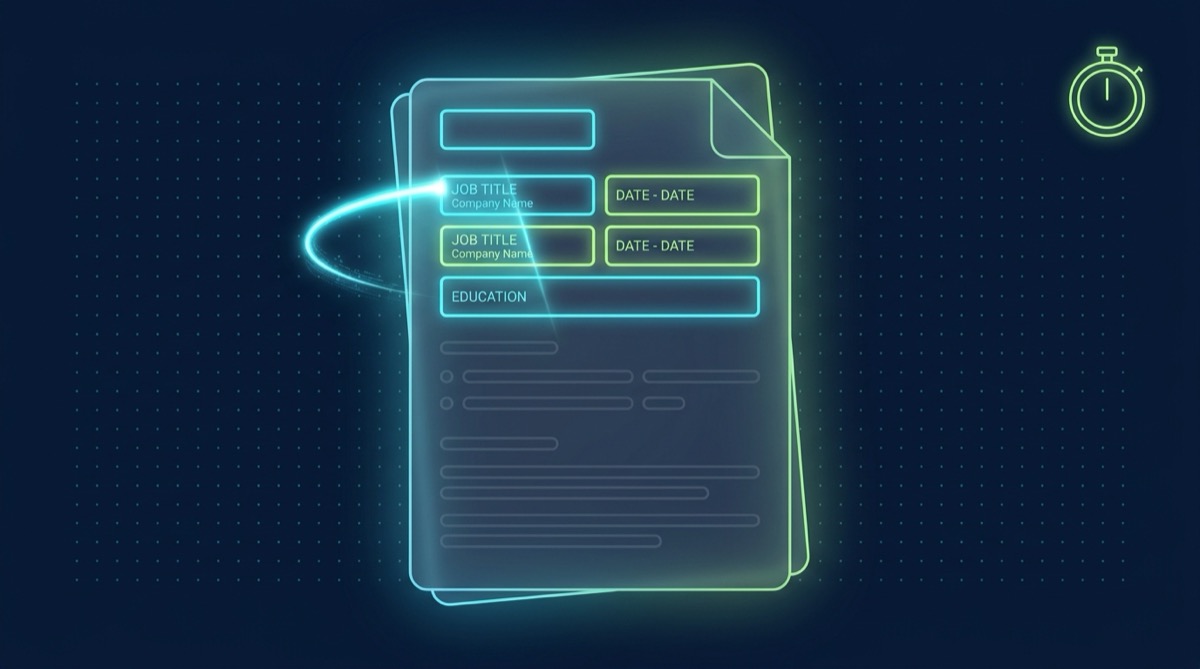
Second, and more useful than the headline number: the study recorded where those 6 seconds actually went. Recruiters spent almost 80% of their total review time on just six data points — not on achievements, not on responsibilities, not on the carefully written bullet beneath them.
- Name
- Current title and company
- Previous title and company
- Current position's start and end dates
- Previous position's start and end dates
- Education
Everything else on the page — every bullet point, every achievement, every quantified result — was competing for whatever attention was left over after those six fields had already been checked.
“80% of the first scan goes to six fields. None of them is a bullet point.”
One Important Caveat Before You Rebuild Your Resume Around This
This is where most articles citing the “6-second rule” stop — and where this one is going to be more careful, because the sourcing matters. TheLadders is a company that sells resume-writing and career-coaching services, which means the study that made it famous is vendor research, not an independently replicated academic finding. That doesn't make the eye-tracking data fabricated — eye-tracking is a real, well-established research method — but it does mean the exact number (6 seconds, 80%) should be read as directional, not as a literal stopwatch fact that applies identically to every recruiter at every company.
TheLadders itself returned to this question with a second eye-tracking study in 2018, covered by HR Dive: the average review time had drifted up slightly to about 7.4 seconds, and the newer study put more emphasis on layout than on any single field — resumes with simple, clearly sectioned layouts following a natural top-to-bottom, left-to-right reading pattern, bolded titles, and bulleted accomplishments were the ones that held attention longest. Cluttered layouts, dense paragraphs, multiple columns, and missing section headers were the ones recruiters' eyes slid past fastest.
Put the two studies together honestly and the finding isn't “recruiters read your resume for exactly 6 seconds and only look at six fields, full stop.” It's closer to: whatever the exact number is on a given day, the very first pass is short, it's weighted heavily toward a handful of structural facts, and good layout is what earns a resume the second, slower look where bullet points actually get read.
The Two-Pass Model: Why Your Bullets Still Matter — Just Not First
This reframes the “put numbers on your resume” advice without contradicting it. Quantified, specific bullet points are still what wins an interview once a resume is actually being read —
this blog has made that case before: specificity beats adjectives every single time, and recruiters trust evidence, not claims. The eye-tracking research doesn't undermine that. It adds a stage in front of it.
Pass one, the 6-to-7-second scan, isn't evaluating your achievements at all. It's a credibility-and-relevance filter: does this person's name, current and previous titles, employment dates, and education look like a plausible, consistent match for this role, with no obvious red flag? Pass two — the slower read that happens only after pass one doesn't trip an alarm — is where your bullet points, your quantified results, and your actual story get evaluated.
A resume can have the single best bullet point the recruiter will see all week, sitting one scroll below a job title that reads as a mismatch, or next to an unexplained 14-month gap in the dates column. If pass one stalls on the mismatch or the gap, that bullet point may never get read at all — not because it was weak, but because the recruiter never got that far.
“Pass one checks if you're plausible. Pass two checks if you're good. A great bullet point can't fix a failed pass one.”
What Actually Gets a Resume Screened Out in Pass One
Given what the eye-tracking data says recruiters are actually looking at in those first seconds, a specific, short list of things matters far more than most candidates assume — and a specific list of things matters far less:
- Job titles that don't clearly map to the role being applied for, even if the actual work overlapped heavily — pattern-matching happens on the label first, the description second
- Unexplained gaps in the employment dates, which read as a question mark before anyone reads far enough to find the answer
- Inconsistent or unclear date formatting, which slows down exactly the field the research says gets checked first
- Company names with no context for an unfamiliar employer, when a one-line descriptor would have resolved the “wait, what did they do” question instantly
- Education or title formatting buried in dense paragraphs instead of a scannable, consistent block
None of this replaces the deeper filter that often runs before a human ever opens the file — most of what gets blamed on “the ATS rejecting resumes” is actually a human recruiter making a fast keyword-match decision, which makes pass one a second, separate filter stacked right after the first one, not a replacement for it.
Passing Both Passes, Not Just One
The practical fix isn't to abandon quantified bullet points — it's to stop treating them as the only thing that matters and spend real, deliberate attention on the six fields the research says get checked first.
- Make the job title on the resume legible against the job title being applied for — a parenthetical clarifier (“Senior Analyst (Data & Reporting)”) costs nothing and resolves the mismatch instantly
- Address a real gap head-on in one short line rather than leaving it for the recruiter to wonder about — a stated reason reads as controlled; silence reads as a question mark
- Use one consistent date format everywhere on the page, and put dates in the same visual position for every entry so the eye doesn't have to hunt for them
- Lead each role with a one-line company descriptor if the company name alone wouldn't be recognizable to someone outside that industry
- Only once that structural layer is clean, spend the effort on the bullet points themselves — specific, quantified, evidence over adjectives
The broader behavioral pattern behind all of this — why a decision this consequential gets made this fast — isn't unique to resumes. A field study of 691 real interviews found a related, more nuanced version of the same snap-judgment instinct playing out once a candidate is actually in the room, which is worth reading if the resume stage is the one you're currently stuck on.
And once the resume itself is doing its job, the next filter is almost always a live conversation about it — a resume gets you the interview, but it's the story behind it that gets you the offer, which is exactly the part worth rehearsing out loud before it happens for real.
Reps matter here the same way they do everywhere else on this blog — how many mock interviews it actually takes before explaining your own resume stops feeling rehearsed is worth answering with real numbers rather than a guess.
Key Takeaways
If you remember only a few things, remember these:
- The “6-second resume rule” comes from a real eye-tracking study of 30 recruiters (TheLadders, 10-week study) — but TheLadders sells resume services, so treat the exact number as directional, not a literal, universal stopwatch fact.
- That study's more useful finding: roughly 80% of the first scan's attention goes to six fields — name, current and previous titles and companies, employment dates, and education — not to bullet points or achievements.
- A 2018 follow-up eye-tracking study (also TheLadders, reported by HR Dive) found average review time near 7.4 seconds and added that clean, simply sectioned layouts with bulleted accomplishments hold attention longest.
- Treat it as a two-pass model: pass one is a fast credibility-and-relevance filter on structural facts; pass two — which only happens if pass one doesn't stall — is where quantified bullet points actually get read and evaluated.
- A mismatched job title, an unexplained date gap, or inconsistent formatting can stall pass one regardless of how good the bullet points underneath them are.
- Fix the six structural fields first, then invest the remaining effort in specific, quantified bullets — both passes matter, in that order.
The candidate who rewrote one bullet point eleven times wasn't wrong to care about it — quantified, specific achievements are still what wins an offer once someone is actually reading closely. The mistake was assuming that bullet point was the first thing anyone would see.
Eye-tracking research on real recruiters says otherwise: the first few seconds are spent somewhere else entirely — on a name, two job titles, two sets of dates, and an education line — checking whether this resume is even worth a second, slower look.
That's not a reason to stop writing great bullet points. It's a reason to make sure the six fields above them are clean enough to earn the chance to be read.
A resume gets you the interview. Rehearsing it gets you the offer.
Practice explaining the story behind your resume — titles, gaps, and the achievements underneath — out loud, with AI feedback on how it actually lands.
Start your career workout todaySee how deliberate, scored practice works
A look at how structured, repeated reps build the skills that actually get evaluated — on a resume, in a screen, and in the room.
Frequently asked questions
- Is the 6-second resume rule actually true?
- It traces to a real eye-tracking study (TheLadders, 30 recruiters, 10-week study) that found an average review time near 6 seconds. Because TheLadders sells resume services, treat the exact number as directional rather than a literal, universal fact — a 2018 follow-up study by the same company found the average had drifted to roughly 7.4 seconds. The more durable finding across both studies is where the attention goes, not the precise second count.
- What do recruiters actually look at first on a resume?
- According to the original eye-tracking study, about 80% of first-pass attention goes to six fields: name, current title and company, previous title and company, current and previous position dates, and education — not bullet points or listed achievements.
- Does this mean bullet points and quantified achievements don't matter?
- No — they matter enormously, just not in the first few seconds. Think of it as two passes: a fast structural-credibility check first, then a slower read where bullet points, quantification, and evidence actually get evaluated. A resume has to pass the first check before the second one happens at all.
- How do I fix a resume that might be failing the first pass?
- Focus on the six fields the research says get checked first: make job titles legible against the role you're applying for, address real employment gaps in one short line instead of leaving them unexplained, use one consistent date format and position, and add a one-line descriptor for unfamiliar company names. Only after that layer is clean does polishing bullet points pay off.
- Is this the same thing as an ATS rejecting a resume?
- No — they're two separate filters, often stacked back to back. ATS-related rejection is usually a human recruiter making a fast keyword and relevance judgment, not an automated system discarding resumes outright. The eye-tracking research described here is about what a human reviewer's eyes actually do once they're looking at a resume, which is a later and different step in the funnel.
Related articles
Does an ATS Really Reject Your Resume Before a Human Sees It?
The number gets repeated everywhere: 75% of resumes are rejected by an ATS before a human ever sees them. It traces back to a company that stopped existing in 2013 and a statistic nobody ever verified.
What Recruiters Notice in the First 90 Seconds of Reading Your Resume
Recruiters don’t read resumes first. They make decisions first — and then read to confirm them.