Knowledge Doesn’t Change Careers. Repetition Does.
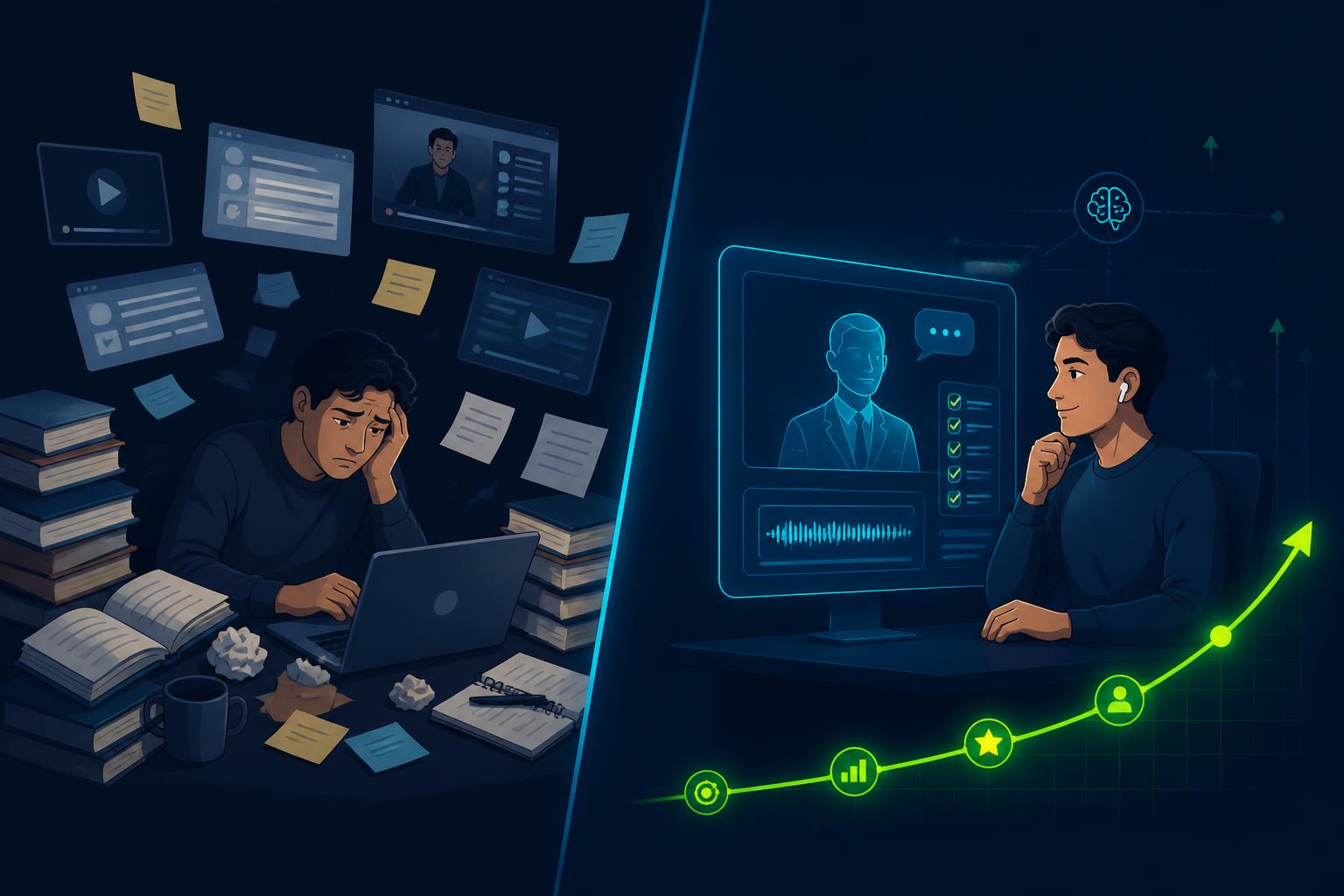
Information can make you smarter. Only repetition can make you better.
Imagine two people. The first has read twenty books about public speaking. They’ve watched TED Talks, taken notes, highlighted passages, saved YouTube videos, followed experts on LinkedIn. The second person has delivered one hundred presentations.
Who would you rather have speaking at your conference? The answer is obvious. Now replace public speaking with interviews. Or leadership. Or negotiation. Or communication. The pattern doesn’t change.
Knowledge creates awareness. Repetition creates ability. Somewhere along the way, we’ve started believing that consuming information is the same as developing a skill. It isn’t — and that misunderstanding quietly holds back millions of careers.
We’ve mistaken learning for improvement
Understanding a framework feels like progress. It isn’t the same thing as being able to use it while a hiring manager watches you think.
If you want to improve your interview skills, don’t start with another article. Start with another rep. Complete your first AI Interview Rep in under two minutes and experience how deliberate practice builds confidence one conversation at a time.
“Knowledge creates awareness. Repetition creates ability.”
The internet made knowledge cheap
Think about almost any professional skill. Want to learn product management? Thousands of articles. Want to become a better designer? Thousands of videos. Want interview advice? Millions of search results.
Information has never been more accessible. That’s an incredible achievement. But it has also created a subtle illusion. Because information is easy to consume, we begin to feel like we’re improving simply because we’re learning.
Psychologists call this the illusion of competence. You recognise an idea. You understand a framework. You nod while reading. It feels familiar, and your brain mistakes familiarity for mastery.
Then reality arrives. The interview begins. The presentation starts. The difficult conversation happens. Suddenly understanding isn’t enough. Performance is required.
Why watching isn’t the same as doing
Imagine trying to learn swimming. You watch Olympic races, study breathing techniques, read books about floating and understand every scientific principle. Then someone asks you to jump into the water. Would you feel confident? Probably not.
Because swimming isn’t a knowledge problem. It’s a performance problem. Interviewing works the same way. Leadership works the same way. Communication works the same way.
Skills are built through execution, not observation.
The education system trained us for the wrong game
Most of us grew up believing success followed a simple formula. Study. Memorise. Take the test. Move on.
That system works surprisingly well for exams. It works far less effectively for careers, because careers don’t reward memory — they reward performance.
Nobody gets promoted because they can define leadership; people get promoted because they lead. Nobody gets hired because they know the STAR Method; people get hired because they communicate experiences clearly under pressure. There’s an enormous difference between knowing something and being able to do it.
The confidence paradox
Ask someone why they don’t perform well in interviews and many will answer: “I need more confidence.” That’s understandable. It’s also backwards.
Confidence isn’t the starting point. It’s the result. Think about riding a bicycle. You didn’t become confident first and then learn to ride. You rode. Fell. Adjusted. Repeated. Confidence arrived later.
Career skills develop exactly the same way. Repetition comes first. Confidence follows. Not the other way around.
“Confidence isn’t motivation. It’s accumulated proof.”
The Knowledge → Repetition → Confidence Loop™
Step 1: Knowledge. You learn a concept — perhaps the STAR Method, or active listening, or product strategy. Knowledge answers one question: “What should I do?” That’s important, but it’s only the beginning.
Step 2: Repetition. Now you apply the knowledge. Again. And again. You answer behavioural questions, present ideas, receive feedback, improve, repeat. Repetition answers a different question: “Can I actually do it?” That’s where transformation begins.
Step 3: Confidence. After enough repetitions, something changes. You stop consciously thinking about every step. Your answers become natural, your communication clearer, your anxiety smaller — not because you’re pretending, but because your brain now has evidence. You’ve done this before, many times.
Step 4: Performance. This is where careers change. The interview feels smoother. The presentation feels easier. The client trusts you. The hiring manager remembers you. The opportunity appears. People watching from the outside often call this “talent.” They rarely see the hundreds of repetitions underneath it.
Why elite performers obsess over reps
Watch professional athletes train. They don’t spend most of their time reading about technique. They repeat movements. Again. Again. Again.
Musicians rehearse difficult passages hundreds of times. Pilots use simulators. Surgeons practise procedures. Firefighters run drills. Why? Because pressure changes performance, and repetition changes how we respond to pressure.
Professionals in every high-performance field understand something many careers have forgotten: you don’t rise to the level of your knowledge, you fall to the level of your training.
The biggest career mistake
The modern professional has access to more information than any generation in history. Yet many still struggle with interviews, communication, presentations and leadership.
Not because they lack knowledge. Because they lack repetitions. They know what good communication sounds like — they simply haven’t practised producing it consistently under pressure. That’s the gap Uinspyr exists to close.
Every rep changes your brain
One conversation probably won’t transform your career. One hundred might.
Every repetition teaches your brain something subtle. “This situation isn’t new.” “I’ve answered difficult questions before.” “I’ve recovered after making mistakes.” “I know how to think under pressure.”
Those small moments accumulate. Eventually, what once felt intimidating begins to feel normal. That’s not magic. That’s adaptation — and adaptation is built through reps.
Feedback is the force multiplier
Imagine two people trying to improve their tennis serve. The first practises alone, over and over. The second practises with a coach who corrects a small mistake after every attempt.
After one session the difference is almost invisible. After one hundred sessions the gap becomes enormous — not because one person practised more, but because one person improved more with every repetition.
This is the missing ingredient in most career development. People collect repetitions but they don’t collect feedback. Repetition without feedback creates habit. Repetition with feedback creates mastery.
“Repetition without feedback creates habit. Repetition with feedback creates mastery.”
The Career Compound Effect™
Most people underestimate how careers actually grow. They imagine promotions as giant leaps. In reality, careers compound.
One better interview leads to one better job. One better job creates better projects. Better projects build stronger experience. Stronger experience creates more confidence. Confidence improves communication. Better communication opens leadership opportunities. Leadership attracts recruiters. Recruiters create optionality. Optionality changes careers.
It all started with one small improvement. Just like investing. Just like fitness. Just like learning a language. Tiny improvements seem insignificant in isolation. Over years, they become life-changing.
AI has changed one thing forever
For decades, deliberate practice was expensive. You needed a coach, a mentor, a manager, a friend willing to help — plus time, scheduling and availability. Most people simply didn’t get enough practice.
AI changes that. You don’t have to wait until your next interview to improve your interview skills. You don’t have to wait for presentation day to become a better communicator. You don’t have to hope your manager gives you feedback. You can practise today, again tomorrow, and the day after.
The biggest gift AI has given professionals isn’t automation. It’s unlimited, accessible practice.
Why information alone doesn’t stick
Think back to the last great article you read. You probably remember the main idea, maybe one quote, perhaps a framework. Now think about the last difficult conversation you had. You probably remember every detail.
Why? Because experiences change us differently than information. Information enters the brain. Experience rewires it.
That’s why deliberate practice works. You’re no longer reading about communication — you’re communicating. You’re no longer studying confidence — you’re building it.
The world’s best professionals train differently
Elite athletes don’t prepare only before competitions; they train continuously. Musicians don’t rehearse only before concerts. Pilots don’t use simulators only before their first flight. The highest performers build systems, not bursts of motivation.
Career growth should work exactly the same way. Don’t prepare only when an interview appears — train every week. Don’t wait until performance reviews to improve communication — practise every week. Don’t wait until leadership opportunities appear — develop leadership habits every week.
Consistency beats intensity. Every time.
The Career Gym philosophy
This is why we call Uinspyr a Career Gym. Not a course platform. Not an interview website. Not a library. A gym.
Nobody expects to become fit after reading about exercise. Nobody expects one workout to transform their health. People understand that fitness is built through reps. Careers deserve the same mindset.
Every interview rep strengthens communication. Every difficult question improves recall. Every piece of feedback sharpens judgment. Every session builds confidence. Progress isn’t dramatic — it’s cumulative. One rep rarely changes your career. A thousand reps almost certainly will.
Stop measuring learning. Start measuring reps
Imagine two professionals after six months. Person A consumed 42 articles, 18 YouTube videos, 6 online courses and 3 books. Person B completed 120 interview reps, 80 communication reps, 40 presentation reps and hundreds of feedback iterations.
Who do you think performs better? Knowledge matters, but execution wins. Always.
The future belongs to professionals who don’t just know more. They practise more.
The new career metric
Most people track the wrong things: salary, job title, years of experience, followers, connections. Those are outcomes.
Instead, track inputs. How many interview reps did you complete this month? How many difficult conversations did you intentionally practise? How many times did you ask for feedback? How many presentations did you deliver? How many new skills did you apply — not just learn?
Measure the reps. The outcomes will eventually follow.
Key takeaways
Knowledge creates awareness; repetition creates capability. Confidence is earned through accumulated evidence, not positive thinking. Feedback accelerates the value of every repetition.
Careers compound through small, consistent improvements. AI makes deliberate practice accessible at any time. Track your reps, not just your achievements.
Imagine two versions of yourself. One spends the next year collecting advice. The other spends the next year collecting repetitions.
At the end of twelve months they’ve both read similar books, watched similar videos and followed similar creators. But one person has completed hundreds of meaningful reps and the other hasn’t. Who gets hired first? Who communicates more confidently? Who earns trust faster? Who gets promoted sooner?
The answer has very little to do with intelligence. It has everything to do with deliberate practice. Because careers aren’t transformed by what you know. They’re transformed by what you can consistently do. Knowledge starts the journey. Repetition changes the destination.
Stop collecting career advice. Start collecting career reps
The professionals who improve the fastest aren’t the ones who read the most — they’re the ones who practise the most. Complete your first AI Interview Rep today: realistic interview scenarios, instant AI feedback, and confidence built one repetition at a time.
Start your first AI Interview RepReady for the full journey?
When you’re ready for a complete, structured interview preparation journey, explore Uinspyr Interview Prep.
Frequently asked questions
- What is deliberate practice?
- Deliberate practice is structured, feedback-driven repetition designed to improve a specific skill. Unlike casual repetition, it focuses on continuous improvement rather than simply accumulating experience.
- Why doesn’t reading more automatically improve my interview performance?
- Reading increases understanding, but interviews require real-time communication under pressure. That ability is developed through repeated practice, reflection, and feedback.
- Can AI really help me improve faster?
- Yes. AI makes deliberate practice more accessible by providing realistic interview scenarios, immediate feedback, and unlimited opportunities to practice without waiting for a human coach.
- How often should I practice interview skills?
- Consistency matters more than intensity. Even a few focused interview reps each week can build confidence and improve communication over time.
- What’s the biggest takeaway from this article?
- Stop measuring how much career advice you consume. Start measuring how many meaningful reps you complete. That’s where transformation happens.
Related articles
What Is a Career Gym? (And Why Every Professional Needs One)
We have gyms for our bodies, academies for athletes, studios for artists and simulators for pilots. But there’s one place that never existed — a gym for your career. Until now.
Stop Learning. Start Training.
Knowledge has become infinite. Execution hasn’t. The people who train, not the people who consume, will define the next decade of careers.