How to Prepare for a Job Interview: The Complete 2026 Guide
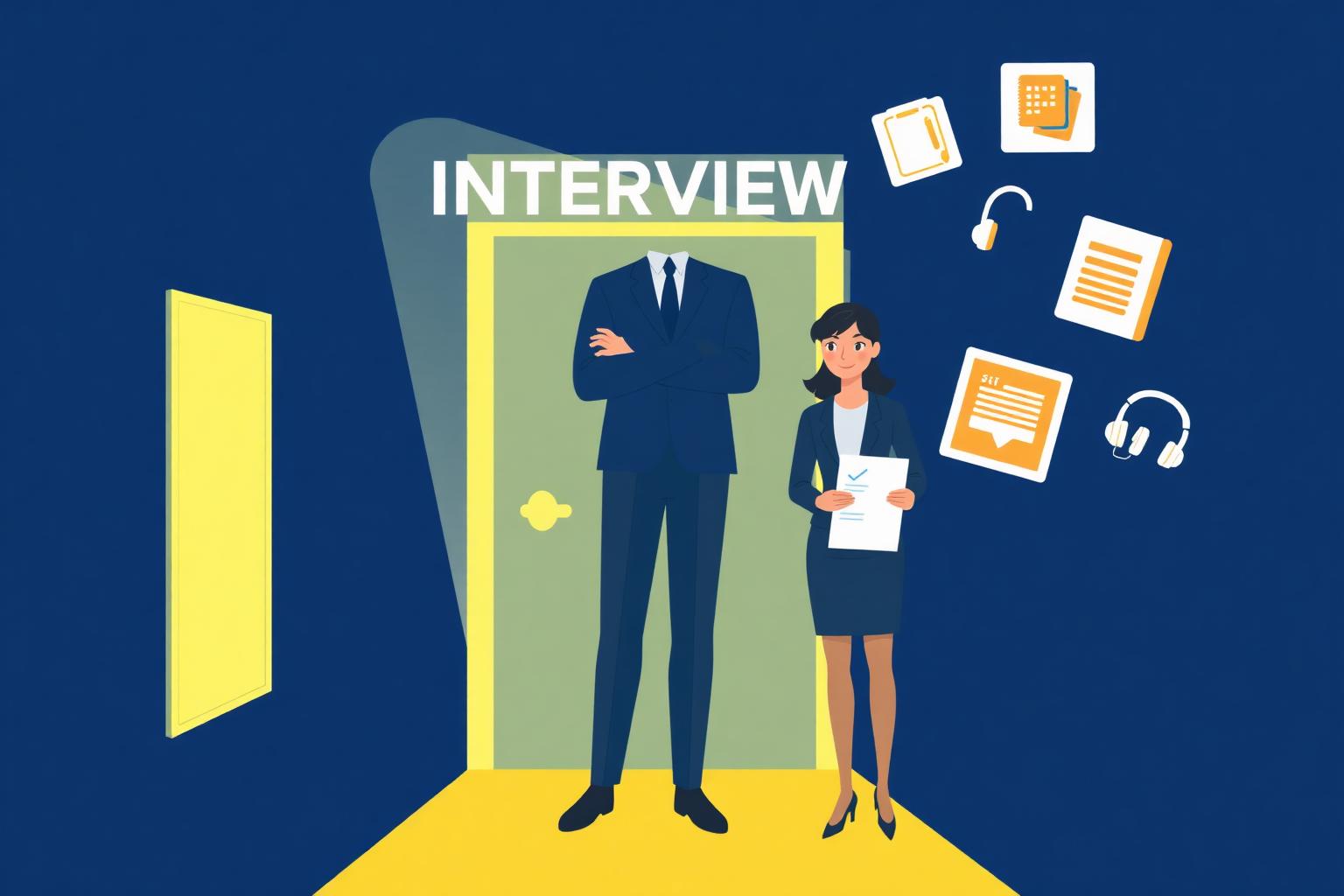
Every job interview is really a 45-minute test of one thing: can you think clearly, communicate crisply and stay calm under pressure?
Most candidates don’t fail because they lack knowledge. They fail because they walked in prepared to “answer questions” instead of prepared to “have a conversation.”
This guide walks you through exactly how to prepare for a job interview — step by step — from the first hour of research to the final mock rehearsal the night before. Follow it and you’ll show up ready, not rehearsed.
1. Start with the job description, not the company
Before you Google the company, read the job description three times. Highlight every skill, tool and outcome it mentions. That list is your interview syllabus — the interviewer will almost always test against it.
For each requirement, write one line: “Here’s a time I’ve done this.” If you can’t think of one, that’s a gap to address in your answers with a related example or a genuine learning story.
2. Research the company like a consultant
Spend 30–60 minutes learning what the company actually does today — not what it did five years ago. Read their homepage, their latest product launches, their careers page, and one recent news article or founder interview.
Then answer three questions for yourself: What problem do they solve? Who are their competitors? What has changed in the last 6 months? Bringing these into your answers signals genuine interest better than any rehearsed “I love your mission” line.
3. Understand the interview format before you prepare answers
Ask your recruiter (or check the invite) exactly what the round covers: is it behavioral, technical, case-based, panel, or a take-home? Each format demands different preparation.
Behavioral rounds test how you’ve handled real situations. Technical rounds test how you think, not just what you know. Case rounds test structured problem solving. Preparing for the wrong format is the single biggest reason smart candidates underperform.
4. Master the STAR method for behavioral questions
Behavioral questions — “Tell me about a time when…” — make up 40–60% of most interviews. Answering them well is a repeatable skill, not a talent.
Use STAR: Situation, Task, Action, Result. Keep Situation and Task to two sentences. Spend most of your airtime on Action — what you specifically did. End with a measurable Result.
“Interviewers don’t remember what you said. They remember how clearly you said it.”
5. Prepare 6–10 stories that cover every likely question
You don’t need 40 rehearsed answers — you need 6–10 sharp stories that can flex to fit most questions. Aim to cover: a leadership moment, a conflict you resolved, a failure you learned from, a project you’re proud of, a time you influenced without authority, and a time you handled ambiguity.
Write each story in STAR form. Then practice telling it in 90 seconds out loud. If it takes more than two minutes, cut ruthlessly.
6. Know your own resume cold
One of the most common ways strong candidates lose interviews is fumbling their own resume. If a project is on your CV, you must be able to explain what you did, why, and what the result was — in under a minute.
Re-read every bullet on your resume and rehearse a one-line story for each. If a bullet no longer represents you well, rewrite it. If you’re not sure your resume is landing at all, our
AI resume analysis gives you an instant read on what’s working and what to fix.
7. Practice out loud — don’t just “think through” answers
This is the single biggest gap between people who get offers and people who don’t. Reading answers in your head feels productive. Saying them out loud reveals every filler word, every tangent and every unclear thought.
Record yourself answering five common questions. Play it back. You’ll be uncomfortable — that’s the point. Every rep sharpens your delivery.
“Silent preparation feels safer. Spoken preparation actually works.”
8. Run at least two mock interviews before the real one
A mock interview simulates the pressure your brain will actually feel in the room. Even one round of live practice will do more for your confidence than five hours of reading.
Old-school mock interviews required a friend, a coach or a paid consultant. Today, AI can generate role-specific questions tailored to your resume, and give you rubric-based feedback on your written answers in seconds— the same way a trainer would.
That’s the whole idea behind
the Career Gym: treating interview skill like a muscle you train, not a book you read.
9. Prepare 4–5 questions to ask the interviewer
The final “Do you have any questions for us?” moment is not filler — it’s a scored part of the interview. “No, you’ve covered everything” is one of the worst answers you can give.
Prepare a mix: one about the role, one about the team, one about how success is measured, and one about the interviewer’s own experience. Thoughtful questions signal seniority regardless of your years of experience.
10. Sort logistics the day before, not the day of
Test your camera, mic and internet at least 12 hours before a virtual interview. Charge your laptop. Put your phone on Do Not Disturb. Have your resume, a notebook and water on the desk.
For in-person rounds, plan to arrive 15 minutes early. Small logistical stress adds up and steals attention from your answers.
11. Manage nerves with reps, not willpower
You can’t “think your way” out of nerves. You have to condition them down. Every mock you run makes the real one feel more familiar.
In the last hour before the interview, avoid cramming. Re-read your six stories, take a walk, drink water and remind yourself: you’ve done the reps. Now you’re just having a conversation.
12. Why AI-powered practice beats one more article
At some point, more reading stops helping. You already know what STAR is. You already know to research the company. What you’re missing is repetition under realistic pressure.
An AI interview trainer generates questions tailored to your resume and the role, evaluates your written answers against a rubric, and tells you exactly what to fix next — relevance, structure, specificity and communication. That feedback loop is what actually builds confidence.
It’s the same shift we wrote about in
Stop Learning. Start Training. — knowledge is free, but performance is trained.
“You don’t rise to the level of your preparation. You fall to the level of your practice.”
— Team Uinspyr
Run your first AI mock interview — free.
Paste your resume or a job description and get a real, AI-scored interview in minutes. It’s the fastest way to turn everything above into confidence.
Start Free Mock InterviewWant a human in the room?
Book a live 30-minute mock interview with real human feedback on how you think and communicate under pressure.
Frequently asked questions
- How long should I prepare for a job interview?
- For most roles, plan 6–10 hours of focused preparation spread over 3–5 days: 1 hour on the job description and company, 2–3 hours drafting and rehearsing 6–10 STAR stories, 2–3 hours on role-specific technical or case practice, and at least 2 mock interviews. Cramming the night before rarely works because interview skill is built through repetition, not reading.
- What is the STAR method and why does it work?
- STAR stands for Situation, Task, Action, Result. It works because it forces you to structure your answer the way interviewers actually score it: context, your specific contribution, and measurable outcome. Without a structure, most candidates ramble; STAR keeps every behavioral answer under two minutes and easy to remember.
- How do I answer “Tell me about yourself”?
- Use a 60–90 second present-past-future arc: what you do today, one or two highlights from your recent past that qualify you for this role, and why this specific role is the natural next step. Avoid reciting your resume top to bottom — the interviewer has already read it.
- What should I do the night before an interview?
- Do not learn anything new. Re-read your 6–10 STAR stories, review your resume, check the interview format and logistics, prepare your questions for the interviewer, and get 7–8 hours of sleep. Confidence the next day comes from the reps you already did, not last-minute cramming.
- Are AI mock interviews as good as human ones?
- For volume and consistency, AI mock interviews are better — they’re available 24/7, never get tired, generate role-specific questions from your resume, and give instant rubric-based feedback on clarity, structure and specificity. Human mocks still win for nuanced judgement and industry-specific coaching. Most candidates benefit most from doing several AI rounds first, then one or two human rounds close to the interview.
- What questions should I ask the interviewer?
- Prepare 4–5 thoughtful questions: one about what success looks like in the role at 90 days, one about the team’s current biggest challenge, one about how the company is adapting to AI or a recent industry shift, and one personal question for the interviewer about their own path. Skip questions whose answers are already on the company website.
Related articles
Amazon Leadership Principles: How to Practice Them With AI (Without Sounding Rehearsed)
Amazon doesn’t interview you on your resume. It interviews you on sixteen sentences — and how honestly your stories map to them.
Google Interview Warmup Is Retired: What Happened and What Should You Use Instead?
Google Interview Warmup has been retired. Here's what actually happened, what Google recommends now, and why talking to an AI isn't automatically the same as training for an interview.