AI Interviews Don't Score You the Way You Think They Do
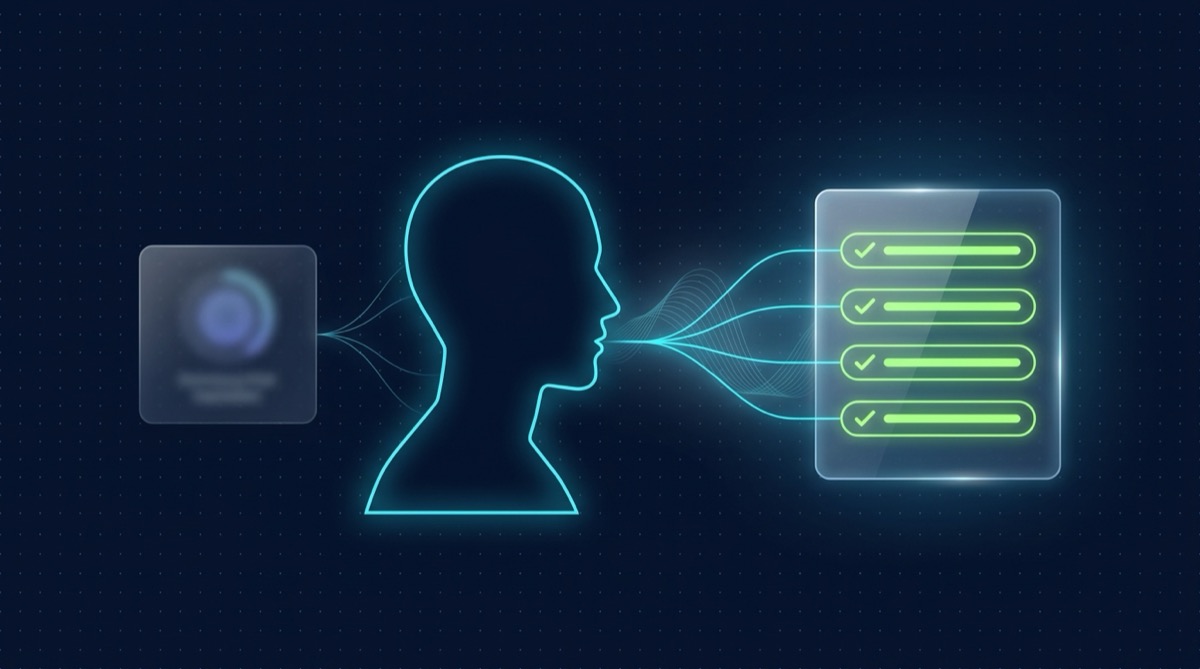
A candidate finishes an AI-conducted screening interview feeling good about it — steady voice, warm opener, confident pauses in the right places. Two days later: a generic rejection, no feedback. Another candidate in the same round stumbles over an opening line and second-guesses an answer out loud mid-sentence, and gets moved forward. Neither result makes sense if you assume an AI interview is scored the way a distracted human interviewer forms a gut read in the first few minutes. That's because it usually isn't.
Most interview-prep advice for AI-conducted rounds is really just human-interview advice, retargeted at a camera instead of a person: sound confident, keep your tone warm, don't let dead air sit too long. That advice exists for a reason — it's a reasonably accurate description of what tips the scale with a human evaluator. The question worth asking is whether it's also true of an AI one, and the research on that question is more specific and more useful than a shrug of "AI is different."
Two threads of research, looked at together, are unusually clear about what changes: what a human interviewer is documented to react to in the first few seconds of a candidate's voice, and what actually moved the needle in a real, 70,000-applicant field experiment comparing AI interviews to human ones. Neither is a hunch or an HR blog's opinion — both are published, checkable research. Here's what they found, and what it means for how you should actually prepare.
What a human interviewer is actually reacting to
Start with the human baseline, because it's the standard most "sound confident" interview advice is quietly optimized for. In 2019, Yale researcher Michael Kraus and coauthors Brittany Torrez, Jun Won Park, and Fariba Ghayebi published a five-experiment study in the Proceedings of the National Academy of Sciences on how accurately people judge social class from speech alone.
The first four experiments established that people can identify a stranger's socioeconomic background from as little as seven spoken words. The fifth went further: 274 people with real hiring experience rated actual job candidates — competence, a starting salary figure, a signing bonus — based only on audio or text transcripts of short self-introductions, with no resumes and no visibility into how the candidates actually performed.
The candidates judged as sounding higher social class were rated more competent and offered more money, regardless of their actual qualifications for the job. Pronunciation carried more signal to the raters than what candidates actually said. It's a close cousin of the perception gap covered in what the HR round is actually scoring — evaluators reading confidence and fit off surface cues rather than off the content of an answer.
“Hiring managers rated competence and set salary figures off a few seconds of speech — before a single answer was actually evaluated.”
What actually changed when the interviewer was AI
In 2025, economists Brian Jabarian (University of Chicago Booth) and Luca Henkel (Erasmus University Rotterdam) ran a real field experiment, not a lab simulation: 70,000+ applicants for a customer-service role were randomly assigned to a screening interview with either a human recruiter or a voice-AI interviewer, at a real company making real hiring decisions.
The results ran in one direction. Candidates interviewed by the AI were 12% more likely to receive a job offer, 18% more likely to actually start the job, and 17% more likely to still be employed 30 days later, with 6% higher 30-day retention among those hired. Candidates also spoke differently in the AI interviews: more clearly, more directly, with fewer filler words and more job-relevant information per answer.
One finding matters most for the question this article is asking: self-reported gender discrimination was roughly half as common among candidates who went through the AI interview compared to the human one. That doesn't mean AI interviews are free of bias — see the honest caveats below — but it's real evidence the AI wasn't reacting to the same surface signals a human evaluator's gut read leans on. It behaves less like a snap judgment and more like a rubric, the same idea covered in how a rubric-scored interview round actually works.
“AI interviewers didn't reward the same things a human evaluator's gut reaction rewards — and the gap shows up in who gets hired.”
So what is an AI interview actually scoring
Neither study reveals the exact scoring model behind any single vendor's product — those are proprietary, and AI now shapes hiring well before an interview even happens, from resume screening to candidate sourcing. But the pattern across the research on interview scoring specifically points at the same few things: whether an answer is specific rather than vague, whether the reasoning holds together across the whole conversation rather than just within one answer, and whether a claim survives a follow-up question rather than just getting restated.
That last part is the one candidates most often get backwards. A generically rehearsed, polished-sounding story clears the bar with some human interviewers on delivery alone — practiced pacing, a confident pause, a tidy conclusion. An AI evaluator checking consistency across an entire conversation isn't grading whether an answer sounded rehearsed. It's checking whether the same story still holds up two follow-up questions later, which a memorized script often doesn't.
This is exactly the failure mode covered in why memorized STAR answers fall apart under an AI interviewer's follow-up questions — the framework itself isn't the problem; treating structure as a substitute for a real, specific, defensible answer is.
In practice, that makes an AI interview closer in spirit to a structured, rubric-scored technical round than to the free-flowing, rapport-driven conversation a lot of candidates picture when they hear "behavioral interview." The scoring criteria are more explicit and applied more consistently, because that's what a system built to run the same evaluation thousands of times over has to do to work at all.
AI interviews aren't automatically unbiased
It would be a mistake to read the Jabarian and Henkel result as "AI interviews are unbiased" — that's a bigger claim than the study makes. It measured one specific outcome (self-reported gender discrimination) in one specific context (a voice-AI screening interview for a customer-service role, at one company). It didn't measure race, disability, or accent-based bias against non-native speakers, or a dozen other dimensions bias can show up on.
AI hiring tools have their own well-documented history of getting this wrong in different ways. HireVue, one of the largest AI-interview vendors, discontinued the facial-analysis component of its scoring in 2021 after researchers and regulators raised exactly this concern: a model trained on past hiring patterns can encode the same biases those patterns contain, just less visibly than a person would. That's a different failure mode from the one the Kraus study documents in humans, not a rebuttal of it.
The honest summary: the research suggests AI interviews score differently than human ones, and in at least one real experiment that difference reduced one specific kind of self-reported bias. It doesn't mean every AI interview tool is fair, and it isn't a reason to stop preparing carefully.
What actually changes about how you should prepare
If an AI interview is scoring specificity, consistency, and whether your claims survive a follow-up question, the preparation that helps is different from, and in most cases more useful than, preparation aimed at sounding confident and warm.
- Answer with specific, checkable detail instead of a smooth, general summary — a number, a decision you actually made, a tradeoff you actually weighed.
- Expect your own earlier answers to get cross-referenced. If you called yourself highly collaborative in one answer, be ready to explain a moment where you made a unilateral call.
- Treat a framework like STAR or CARL as a way to organize a real answer, not a script to recite — the structure helps you; it isn't what's being scored on its own.
- Don't perform confidence you don't feel. A steady, specific answer delivered with a normal amount of hesitation reads fine to a system checking content, in a way it sometimes doesn't to a distracted human.
- Rehearse out loud, more than once, on real questions — not to sound smoother, but because the second and third pass through an answer is usually when the vague version turns into the specific, defensible one.
That last point is worth taking seriously: how many mock interviews it actually takes before an answer stops feeling rehearsed and starts feeling like your own has real numbers behind it, and the mechanism is the same one that matters here — repetition is what turns a general answer into a specific one, and specific is what an AI evaluator is actually built to notice.
If the format you're actually facing has no live interviewer at all — a recorded, one-way video interview — the same content-over-charisma scoring shift applies, with its own specific mechanics and a real regulatory right worth knowing about.
Key Takeaways
If you remember only a few things, remember these:
- A 2019 PNAS study (Kraus, Torrez, Park & Ghayebi) found human evaluators judged competence and set salary offers from just a few seconds of speech, based on perceived social class, before any answer was actually evaluated.
- A 2025 field experiment with 70,000+ real applicants (Jabarian & Henkel) found candidates interviewed by AI got more job offers, started and stayed in jobs more often, and reported about half as much gender discrimination as those interviewed by humans.
- The evidence points to AI interviews scoring specificity, internal consistency across the whole conversation, and how an answer holds up under follow-up questions — not vocal tone, accent, or polish.
- This isn't proof every AI interview tool is unbiased. It's evidence for one specific kind of bias reduction, in one real study, not a blanket guarantee.
- The preparation that actually helps is specific, checkable detail and answers that survive follow-up questions, not a more confident-sounding delivery.
None of this makes an AI interview easier in the way most candidates hope for — there's no shortcut where sounding polished carries the round on its own. If anything it raises the bar in a different place: the content of your answer now matters more than it might have with a distracted or biased human interviewer who was, whether they'd admit it or not, partly reacting to how you sounded in the first few seconds.
That's mostly good news. Preparation built around specific, defensible answers — the kind that survives a real follow-up question — is preparation that transfers. It helps in an AI-scored round, and it helps in a human one, because a well-structured, specific answer reads well to both. The habit some candidates rely on instead, a smooth, rehearsed-sounding delivery standing in for actual substance, is the one that stops working once the evaluator is checking whether the story holds up two questions later.
The shift worth making isn't about performing differently for a machine. It's dropping the idea that performance was ever the actual target.
Practice on what's actually being scored.
Rehearse real questions with AI feedback on specificity, consistency, and how your answers hold up under follow-up questions — not on how confident you sounded.
Start your career workout todaySee how deliberate, scored practice works
A look at how structured, repeated reps build answers that hold up under real follow-up questions, not just answers that sound good once.
Frequently asked questions
- Does an AI interview judge my accent or how I sound?
- The research on humans is clear that accent and perceived social class shape human evaluators' judgments, often within a few seconds (Kraus et al., 2019, PNAS). The best available evidence on AI interviews, a 2025 field experiment with 70,000+ applicants (Jabarian & Henkel), found AI-interviewed candidates reported roughly half as much gender discrimination as human-interviewed ones, suggesting AI evaluators lean less on those surface cues. That's evidence for one specific kind of bias reduction in one study, not a guarantee that every AI interview tool ignores accent entirely.
- Are AI interview scores fair?
- More fair on some dimensions than human interviewers, less studied on others. The Jabarian & Henkel field experiment measured self-reported gender discrimination specifically, not race, disability, or accent bias directly. AI hiring tools also have their own documented failure modes — HireVue dropped its facial-analysis scoring in 2021 after bias concerns. Treat "AI interview" as meaning "scored differently," not "automatically fair."
- Can I tell if I'm talking to an AI interviewer?
- Most legitimate AI interview platforms disclose this upfront, usually in the invite or at the start of the call. If it's genuinely unclear, the safest assumption is to answer as if the conversation will be checked for internal consistency, since that's true of a growing share of both AI and human-assisted screening today.
- Should I still use the STAR method in an AI interview?
- Yes, as a way to organize a real, specific answer, not as a script to recite. The research on what AI evaluators check, holding a story consistent across follow-up questions, means a memorized STAR answer with no real substance behind it is more likely to fall apart under a follow-up than it would in a shorter human interview that never asks one.
- How is preparing for an AI interview different from preparing for a human one?
- Less emphasis on projecting warmth and confidence, more emphasis on specific, checkable detail that survives a follow-up question. The underlying skill, a well-structured, honest, specific answer, helps in both formats; the delivery polish that sometimes carries a weaker answer with a human interviewer carries much less weight with a system checking content and consistency.
Related articles
Does Eye Contact Still Matter in an AI Video Interview? What Two New Studies Found
One 2024 study found looking away from the camera scores worse than having no video at all. A 2025 study found software that fakes eye contact for you barely moves the needle. Here's what that actually means for your next AI-moderated interview.
One-Way AI Video Interviews Aren't Scoring Your Face Anymore — Here's What They Score Instead
You get a link, a webcam, and a countdown timer — no interviewer on the other end. Most advice about that moment is about your face. The research says your face stopped being the point in 2021.