Does Interview Order Affect Your Score? What 35,000 Real Interviews Found
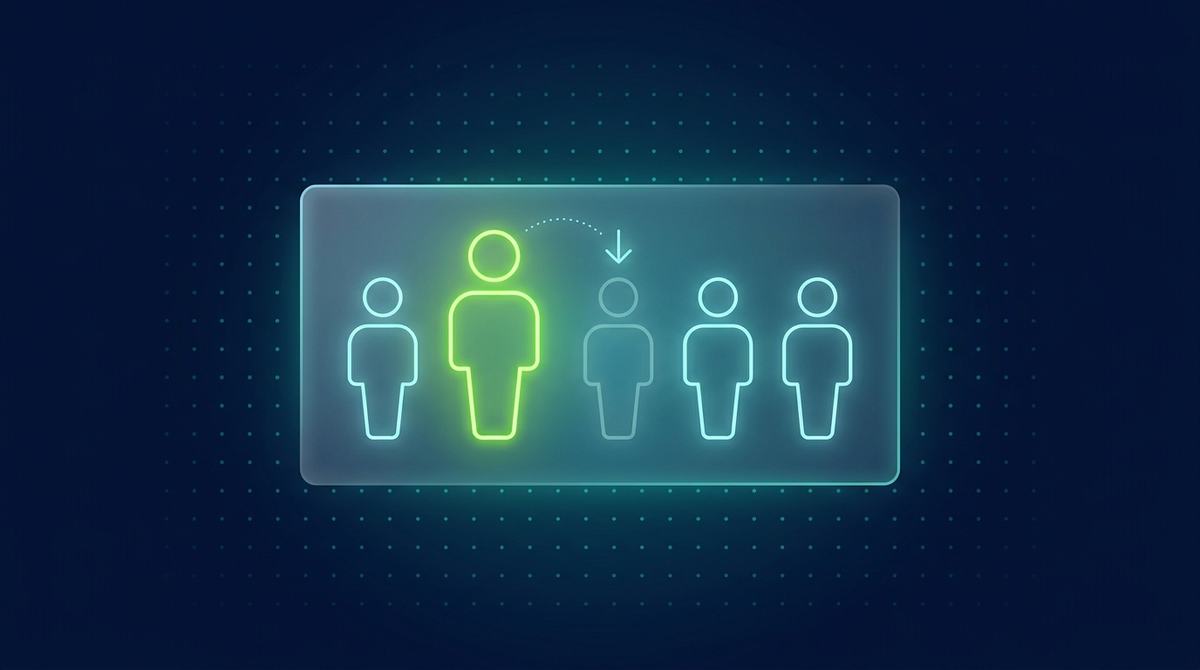
Candidates obsess over what they can control in an interview: the answer they give, the story they tell, the suit or no-suit decision. One thing almost nobody thinks about — because it genuinely isn't visible from the candidate's side — is where they land in the interviewer's schedule that day. Fourth of six? Second of three? Right after the strongest candidate the interviewer has seen all week?
A large study published in 2024 by two economists found that slot order isn't a footnote. It's one of the biggest, most consistent distortions in how interview panels actually score people — bigger than almost anything a candidate can do differently in the room.
Here's what the research measured, how large the effect actually is, why it happens, and the one thing about it that's genuinely useful to know as a candidate.
The Study: 35,000 Interviews, Two Real Hiring Processes
Economists Jonas Radbruch (Humboldt University of Berlin) and Amelie Schiprowski (University of Bonn) published "Interview Sequences and the Formation of Subjective Assessments" — accepted at the Review of Economic Studies, one of economics' top-five journals — after analyzing more than 35,000 real interviews from two separate, high-stakes selection processes: admission interviews for a prestigious German university scholarship program, and the hiring process at a large consulting firm.
What made the data unusually clean for research purposes is that candidates were quasi-randomly assigned to both an evaluator and a position in that evaluator's schedule — not by the candidates' own choice, and not in a way that correlated with how strong a candidate actually was. That's what let the researchers isolate a pure order effect: with assignment effectively random, any pattern in the scores can't be explained by stronger candidates clustering at certain times.
Evaluators interviewed several candidates in a row, over one or two days, and recorded a hire/admit recommendation after each one. The question the researchers asked was simple: does a candidate's score depend on anything other than that candidate's own interview?
“Candidates were randomly assigned to interview slots. Their scores still depended heavily on who went before them.”
The Effect: Following a Strong Candidate Can Cost You Up to 40%
The answer was yes, and by a wide margin. Evaluators were up to 13 percentage points — roughly 40% — less likely to recommend a candidate if they had recommended the previous candidate they'd just seen. The researchers call this negative autocorrelation: a win for the person before you quietly makes a win for you less likely, even though your actual performance had nothing to do with theirs.
This isn't the panel consciously trying to be 'fair' by spreading recommendations around, and it isn't a fixed quota. It's a contrast effect: evaluators build an implicit mental benchmark from the most recent candidate they saw, and judge the next person against that benchmark rather than against an absolute standard. A genuinely good answer can look merely average right after an exceptional one — and a mediocre answer can look fine right after a weak one.
- The effect was strongest when consecutive candidates were similar to each other — same gender, similar academic or professional background.
- It was strongest with short gaps between interviews, and weakest when evaluators had a longer break between candidates.
- It was strongest early in an interview day, before an evaluator had seen enough candidates to recalibrate.
- Evaluator experience, seniority, and interview training did not reduce the effect — this isn't something panels train their way out of.
What the Researchers Tried — And What Didn't Help
Because this is a well-designed field study and not just an observational finding, the authors also tested whether anything could reduce the distortion. A light awareness intervention — simply briefing evaluators on the pattern and asking them to watch for it — did not reduce the effect. Knowing about a bias, on its own, doesn't neutralize it; this matches a broader finding across decades of bias research.
Two approaches did show real promise, though neither is something a candidate controls. Deliberately reordering candidates to minimize similarity between back-to-back interviews was predicted to meaningfully cut the distortion. And collecting a second, independent assessment for borderline candidates reduced the effect on final decisions — slowly, but genuinely — because it gives a candidate a second shot at being judged against a different mental benchmark.
This sits alongside a broader pattern in how interview panels actually form judgments — the research on when and how an interviewer's decision actually takes shape keeps turning up mechanisms candidates have no way to see from their side of the table.
“A briefing that told evaluators about the bias didn't fix it. Knowing isn't the same as correcting.”
Why a Bad Slot Isn't a Verdict on Your Performance
The single most useful thing about this research, for a candidate, is what it rules out. The effect the authors measured has nothing to do with anything you did. It's a property of the evaluator's recent memory, not your answers. If you're interviewed right after someone exceptional, the contrast effect working against you is a quirk of human judgment formation — not feedback on your fit for the role.
That matters because candidates routinely do the opposite: they walk out of an interview, feel it went fine, then get a rejection and spend weeks re-litigating every answer they gave, assuming the fault must be in something they said. Some rejections genuinely are about the answers. Some, per this research, are mechanically about schedule position and completely unrelated to anything in the room.
The same caution applies to other scheduling myths worth being skeptical of — time-of-day effects on interview scoring turn out to be real in some contexts and overstated in others, and the honest answer in both cases is that you can't fully control it, and it matters less than preparation does.
What's Actually Worth Doing With This
You almost never get to choose your slot order, and trying to game it isn't a realistic strategy. But a few things are worth taking from this research:
- Don't diagnose a rejection from a single data point. If you felt genuinely good about an interview and got turned down, schedule position is one of several plausible explanations that have nothing to do with your preparation — alongside headcount changes, an internal candidate, or budget shifts you'll never see.
- If a process gives you any real choice — rescheduling a panel round, picking from open slots — there's no way to know who else is on that day's schedule, so this isn't something to optimize around. It's more useful as a reason not to spiral over a result than as a lever to pull beforehand.
- If you're ever the one running interviews — screening a junior hire, sitting on a hiring committee, judging a competition — this research is a direct, evidence-backed reason to take a short break between evaluations and to write down your assessment of each candidate before seeing the next one, rather than relying on memory and comparison.
- Multiple independent rounds genuinely help candidates who get an unlucky slot. If a process includes more than one interviewer or round, that structure is quietly working in your favor regardless of how any single conversation went.
None of this changes the one variable that's actually yours to control every time: how specific, structured, and well-rehearsed your answers are going in — which is a question of reps, not luck.
And if a panel round does go against you for reasons that had nothing to do with your answers, the parts of your preparation that are actually under your control are exactly where it's worth putting the energy instead.
Key Takeaways
If you remember only a few things, remember these:
- A 2024 study of 35,000+ real interviews (Radbruch & Schiprowski, Review of Economic Studies) found evaluators were up to 13 percentage points — about 40% — less likely to recommend a candidate right after recommending the previous one, even though candidates were randomly assigned to slots.
- This is a contrast effect: evaluators judge against a mental benchmark set by the most recent candidate, not an absolute standard.
- The effect was strongest between similar candidates, with short gaps between interviews, and early in an interview day. Evaluator experience and training did not reduce it.
- Simply telling evaluators about the bias didn't fix it. Reordering candidates and adding independent second assessments showed more promise — but neither is something a candidate controls.
- A bad slot is a property of the evaluator's recent memory, not a verdict on your performance — it's a reason not to over-diagnose a single rejection, not a reason to walk in already defeated.
Most interview advice assumes every rejection has a findable cause in your own performance, and most candidates internalize that assumption completely. A 35,000-interview, peer-reviewed study says that isn't always true: sometimes the deciding factor was who walked in before you, filtered through a cognitive shortcut the evaluator wasn't even aware of using.
That's not a reason to stop preparing — it's a reason to stop treating every outcome as fully diagnostic of your answers. Control what's actually yours to control, and let go of re-litigating a result that may never have been about you in the first place.
Control what's actually yours to control
You can't choose your slot in someone else's schedule. You can control how specific, structured, and rehearsed your answers are. Practice out loud and get feedback on what's actually being evaluated.
Start your career workout todaySee how Uinspyr's AI Interview Reps work
Deliberate, repeated practice builds answers that hold up regardless of what happened in the room before you walked in.
Frequently asked questions
- Does the order you're interviewed in actually affect your score?
- Yes, according to a 2024 study of over 35,000 real interviews published in the Review of Economic Studies. Evaluators were up to 13 percentage points (about 40%) less likely to recommend a candidate immediately after recommending the previous one — a contrast effect, not a reflection of the later candidate's actual performance.
- What is a contrast effect in interviews?
- A contrast effect is when an evaluator judges a candidate against a mental benchmark formed by the most recent candidate they saw, rather than against an absolute standard. A genuinely strong answer can look average right after an exceptional one, and a weak answer can look acceptable right after a poor one.
- Can interviewers correct for this bias if they know about it?
- Not easily. The 2024 Radbruch and Schiprowski study found that briefing evaluators on the pattern did not reduce it. Structural changes — deliberately spacing out similar candidates, adding independent second assessments for borderline cases — showed more promise than simply raising awareness.
- Should I try to pick a specific interview slot to avoid this effect?
- There's no practical way to do this, since you can't see who else is scheduled around you. It's more useful as context for interpreting a surprising rejection than as a strategy to plan around beforehand.
- If I get rejected after a strong interview, does this research mean it wasn't my fault?
- It means schedule position is one of several real, well-documented explanations for a surprising outcome that have nothing to do with your preparation. It doesn't mean every rejection is explained this way — but it's a legitimate reason not to assume a single rejection proves something was wrong with your answers.
Related articles
Does Interview Time of Day Actually Affect Your Score? What a 104,000-Exam Study Found
A recruiter offers you a choice: 9 a.m. or 4 p.m. A 104,552-exam study found a real gap between time slots — just not in the context most 'best time to interview' advice assumes. Here's what the research actually shows.
Interviewers Don't Actually Decide in the First Four Minutes
Career advice says you have four minutes to make your case. A 691-interview field study found the opposite — and the reason interviewers who decide fast should worry you, not reassure you.